List of Works
Click on the title of each work to learn more or purchase a score. If you’re interested in a score which isn’t listed here, don’t hesitate to contact me.
Choral

Everyone Was A Bird for TTBB choir and piano accompaniment. Poetry by Siegfried Sassoon.
***This download is for one authorized use and is not to be copied or distributed.***
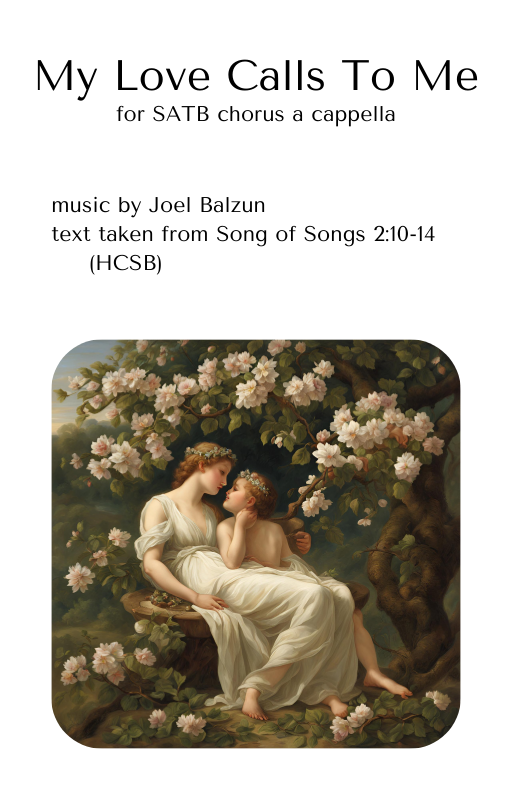
My Love Calls To Me for SATB choir a cappella. Text taken from Song of Songs 2:10-14 (HCSB)
This short processional was written as a wedding gift to my wife, Eleanore. Amidst the text-painting of the trees blooming as a symbol for our growing relationship is a cipher which spells Ellen’s full first name. This cipher first appears on the words, “Come away, my beautiful one” after changing key from A to B. The key change itself represents Ellen’s transition from a single to married woman, as her surname initial changed from A to B.
***This download is for one authorized use and is not to be copied or distributed.***

SATB choir with double wind quintet (2 flutes, 2 oboes, 2 clarinets, 2 bassoons, 2 french horns)
Marjorie Pickthall is an oft-forgotten Canadian writer and poet. Her short life yielded an output of fiction and poetry which is unabashedly lyrical and romantic. Full of youthfulness and fresh imagery, Daisy Time is a simple celebration of the arrival of spring and the fresh flora which comes with it. There is something distinctly Canadian in the feel of the text due to the beauty, pride and celebration found within the imagery. As with any attempt at text-setting, the music strives to paint the different colours found in the flora of the poetry using a variety of effects, including twinkling whistles to describe stars reflected in the dew of the grass, airy tones from both the instruments and singers to send wind through the music, and ultimately a "Superbloom" effect at the end of the piece which portrays the glory of flora in full-bloom.
The Canadian-ness of this text was attractive upon receiving this unique commission from Windago, which boasts a doubled wind quintet as part of the ensemble. In preparation for the premiere, it was discovered that Marjorie Pickthall had actually attended school just down the street from Windago's performance venue. This piece gained new meaning as, many years after Pickthall's death, this music gave her a brief but sweet homecoming.
Song of the Daisies was commissioned by conductors Leah McGray and Elaine Choi for their ensemble, Windago. The premiere performance was conducted by Leah McGray on July 3, 2013 at Timothy Eaton Memorial Church on St. Clair Avenue in Toronto, just two blocks away from Marjoie Pickthall's high school alma mater, The Bishop Strachan School on Lonsdale Road.
Daisy Time
See, the grass is full of stars,
Fallen in their brightness;
Hearts they have of shining gold,
Rays of shining whiteness.
Buttercups have honeyed hearts,
Bees they love the clover,
But I love the daisies' dance
All the meadow over.
Blow, O blow, you happy winds,
Singing summer's praises,
Up the field and down the field
A-dancing with the daisies.
- Marjorie Pickthall
***This download is for one authorized use and is not to be copied or distributed. For this piece only, an ensemble librarian is authorized to make duplicates of the choral octavo for rehearsal and performance.***
instrumental ensemble
Click HERE for score sample.
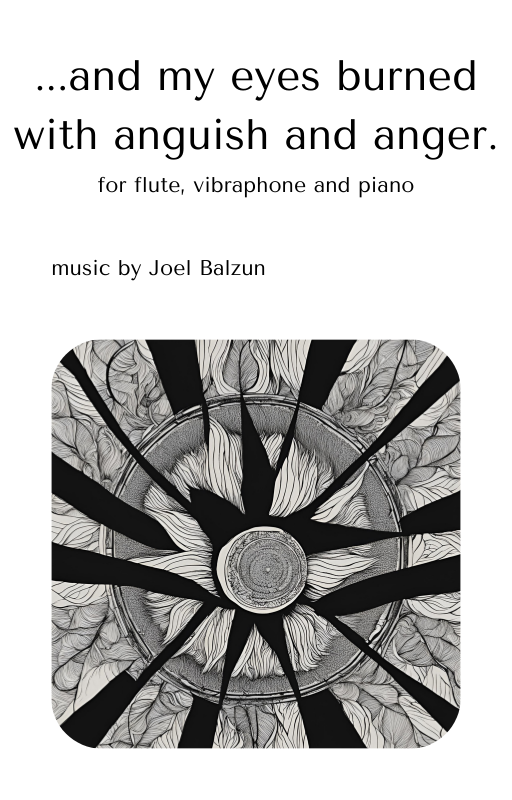
The title for this piece comes from the closing lines of James Joyce’s short story Araby. The story follows a young boy as he pines for his friend’s sister. Narrating his own journey, the coming-of-age story ends with dejection. Although this expression of grief is about unrequited love, the sensational description is a perfect summary of the sudden standstill experienced when affliction and suffering strike.
…and my eyes burned with anguish and anger. was commissioned by the Atlantic Music Festival Contemporary Ensemble.
***This download is for one authorized use and is not to be copied or distributed.***
Instrumentation: 3(3=picc).2(2=eh).2.2 - 2.3.3.1 - timp+2 - hp - str.
***This download is for one authorized use and is not to be copied or distributed.***
Click HERE for score sample
for brass ensemble with percussion (2020)
Instrumentation:
4 Bb Trumpets
4 French Horns
3 Tenor Trombones
Bass Trombone
Tuba
Timpani
Percussion (Snare Drum, Bass Drum)
The "fanfare" has a rich history of celebration, honoring a special occasion or person(s), so stepping into its space comes with great responsibility and pressure. It is my hope with Eastman Centennial Fanfare that my music honors the great tradition and legacy established by the Eastman School of Music, while looking forward with great anticipation to its future. The main melodic cells are derived from musical ciphers of the words Meliora (E-flat, A-flat, G, D-flat or in solfege Me-Li-(s)O(l)-Ra) and Eastman (E, A-flat, B, E-flat, G or E-As-T(i)-Ma-N using a combination of solfege, note names and a musical cryptogram).
Eastman Centennial Fanfare was commissioned by Eastman School of Music as part of their 2021-2022 Centennial Celebration.
***This download is for one authorized use and is not to be copied or distributed.***

Gestalt I: Continuation is written for piano, percussion, and two players. The two instrumental parts are written in concert pitch. As written, they can be performed by the following instruments:
Player 1 – flute (premiere performance), piccolo, e-flat clarinet, soprano saxophone, xylophone, violin
Player 2 – alto flute (premiere performance), alto saxophone, marimba, vibraphone, xylophone, violin, viola
If a player of another instrument desires to play this piece, octave displacement is acceptable. This would open up performance to piccolo, bass flute, oboe, english horn, b-flat clarinet, bass clarinet, bassoon, tenor saxophone, and baritone saxophone, among others.
***This download is for one authorized use and is not to be copied or distributed.***

Flute (doubles Alto Flute in G), Clarinet in B-flat (doubles Bass Clarinet in B-flat), Violin, Cello, Piano (doubles Maracas), Percussion (2 Bender Gongs, Brake Drum, Maracas, Sizzle Cymbal, Tam-tam, 2 Tom-toms, Wood Block, Xylophone)
The title of this piece comes from II Corinthians 3:3, which reads: “And you show that you are a letter from Christ delivered by us, written not with ink but with the Spirit of the living God, not on tablets of stone but on tablets of human hearts.” While the title obviously alludes to this verse, the piece does not necessarily seek to paint a picture of exactly what the verse is saying in a programmatic sense – that is, paint the images of the verse in a descriptive manner so that the music tells a story. Rather, I aimed to use untraditional sounds and rhythmic proportions to challenge the notion of “goodness”; this piece asks the question, “What is truly good; what makes goodness inherently good?” Although the piece at first sounds jarring due to the textual/notational translation to derive the pitch sets, ultimately the harmonies used are justified through theoretical means, and the rhythms are derived from a morse-code translation of the verse. The piece has unity and holds itself up, just as the “letter from Christ” shares these traits, although it may not always be obvious.
On Tablets of Human Hearts was commissioned by Standing Wave Ensemble, who gave the world premiere in Vancouver, BC, on April 13, 2014.
***This download is for one authorized use and is not to be copied or distributed.***

Click HERE for score sample
Teresa of Ávila, also called Saint Teresa of Jesus or Santa Teresa de Jesús (1515-1582), was a Spanish Carmelite nun who was also known as a mystic. Her beliefs and reforms were viewed as controversial, especially in the face of the Spanish Inquisition, but her legacy continues to be celebrated in various denominations of the contemporary Christian church. Her book, The Interior Castle (El Castillo Interior, also known as The Mansions or Las Moradas) shares a vision revealed to her which outlines the journey of the human spirit. It is this book which serves as the basis for Las siete moradas de Santa Teresa (The seven mansions of Saint Teresa).
Saint Teresa’s vision describes the soul as a castle-shaped diamond containing seven successive mansions: “...que es considerar nuestra alma como un castillo todo de un diamante o muy claro cristal...” (...this is to consider our soul as a castle entirely made of diamond or very clear crystal...). She describes the exterior of the castle as being infested with snakes and other venomous creatures; this is life without God. There are seven “diamonds” or “crystals” written into the music to represent each mansion, while remaining outside of the castle. The subsequent music and accompanying electronic sounds aim to distinctively describe each mansion.
The first mansion describes the soul as being surrounded by sin and starting to seek God’s grace. She also writes: “...en estas moradas primeras aún no llega casi nada la luz que sale del palacio donde está el Rey...” (“in these first mansions, the light that comes from the palace where the King is hardly reaches...”). In the second mansion, the soul is instructed to “abrazaos con la cruz” (“Embrace the cross”) as it humbly advances through the castle through daily thoughts of God and prayer. The theme of humility continues in the third mansion, where God begins the work of purification of the soul. Through this purification, the soul gains a desire to seek service for God’s glory. Saint Teresa describes humility as “el ungüento de nuestras heridas” (“the ointment for our wounds”).
The next three mansions are decidedly more mystical than the first three. Indeed, while traversing these mansions, Saint Teresa reported fits of ecstasy, levitation, visions, and other spiritual phenomena. Light preparations are applied to the piano to create a slightly different sound world, while the traditional Spanish “bolero” rhythm serves as the rhythmic foundation to ground the music. The fourth mansion is marked by the “Prayer of Quiet” (“Oración de quietud”) as the presence of God increases in the soul. Saint Teresa uses the image of the silkworm (La gusano de seda), which lies dormant for much of winter before spinning beautiful silk in the spring, to suggest as the soul dies in its earthly ways, it is preparing itself to receive beautiful gifts from God. The sixth mansion is perhaps the most spiritually trying, as the soul continues to be torn between the ways of God and outside temptations and experiences intense spiritual phenomena ranging from rapture and flight of the spirit to wounding and dryness of the spirit. Saint Teresa describes the soul as being suspended “in prayer with trance or ecstasy or rapture...” (“...cuando suspende Dios el alma en la oración con arrobamiento o éxtasis o rapto...”). In this section, a ballad tune from Llibre Vermell de Montserrat (a manuscript of medieval Spanish devotional texts and sacred folk tunes) called “Los Set Gotxs” or “The Seven Joys,” describing the seven joys of Mary.
The seventh and final mansion describes the achievement of ultimate clarity in prayer and spiritual marriage with God, which has been in preparation since the fifth mansion. This mansion is not necessarily a mansion which can be found, as Saint Teresa says it is “...adonde sólo Su Majestad mora, y digamos otro cielo" (“...where only His Majesty dwells: let’s call it another heaven”). A virelai from the Llibre Vermell is used in this final section, “Ad Mortem Festinamus” or “We hasten towards death” – a sentiment which Teresa joyfully celebrates not out of a state of depression, but in joy of God and what treasures He keeps for us in heaven.
Las siete moradas de Santa Teresa is written as a graduation gift to my dear wife, Ellen, as she finishes her Master’s degree in Spiritual Formation and Soul Care. I look forward to moving through these mansions with you for the rest of our lives.
***This download is for one authorized use and is not to be copied or distributed. Download includes patches for electronics to be used with Ableton; Ableton software not included.***

2nd Place Winner, Pierre Mercure Award in the 2017 SOCAN Foundation Awards for Young Composers
Lake Louise is a very special place. Located 2 hours away from where I grew up, I really consider it to be a familiar part of my own backyard. Hikes up to the teahouse by Lake Agnes, wandering through the fancy Chateau, and continuously marvelling at the too-blue-to-be-true colouring of Lake Louise itself are memories that define part of my childhood growing up in Western Canada. The lake itself is an immensely popular tourist attraction, not to mention a popular getaway spot for those more local to Lake Louise or Banff. The water's signature emerald colouring is a sight not easily forgotten. Now that I live far away from Calgary (and Lake Louise), I cherish each chance I have to go to Lake Louise, or Banff, or simply stare at the Rocky Mountains as I drive in the northern part of Calgary. The familiarity and beauty of sights like this is something that brings comfort and peace, regardless of what's happening around me.
Louise was commissioned by Katrina Leshan.
***This download is for one authorized use and is not to be copied or distributed.***

Proseuche is the Biblical Greek word for “Prayer,” as used in the Lord's Prayer in the Synoptic Gospel of Matthew. Written largely as an incantation or meditation, the pitch content for Proseuche is entirely based off of the Lord's Prayer, as found in this Gospel, without the added doxology. The text was translated into a cryptogram, and then organized without repetition. Each petition of the prayer is marked by a motive, whose cryptogram reads “Father Son Holy Spirit.” This motive can suggest the sign of the cross; in some instances, its downward trajectory can also suggest the motion of kneeling. Some rhythms have also been created through translating corresponding parts of the prayer into morse code; this method was only used when describing the will of God, and forgiveness – something that, perhaps, can be viewed as synonymous in this context. This is to say, God wills to forgive those who ask for forgiveness.
Proseuche was commissioned by Chrissy Johnson (née Shattuck).
***This download is for one authorized use and is not to be copied or distributed.***

“Once you 'got' Pop, you could never see a sign again the same way again. And once you thought Pop, you could never see America the same way again.” - Andy Warhol
***This download is for one authorized use and is not to be copied or distributed.***
opera
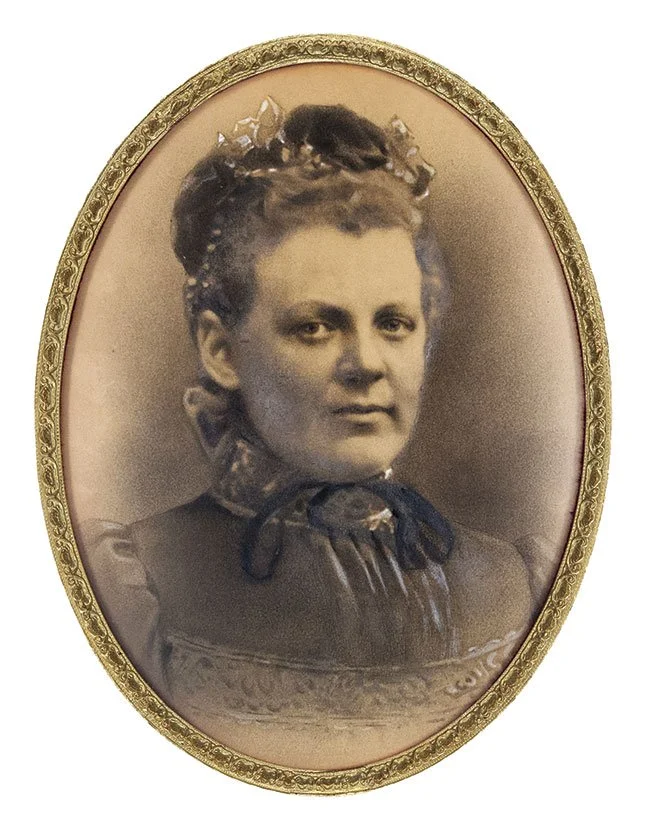
Reduction of Flora’s aria from Clive Hamilton, for mezzo-soprano (or contralto) and piano.
About the aria
Clive Hamilton is a fictionalized account based on true events of the early life of C. S. Lewis, including his service in World War I and the publication of his book of poetry, Spirits in Bondage. The prologue of the opera is set in Belfast, Ireland on August 23, 1908 and provides a fictionalized portrayal of the death of Lewis’ mother, Flora. The text of this aria is a sonnet, “To Sleep” by John Keats, a poem which was very influential on Lewis’ poetic style.
***This download is for one authorized use and is not to be copied or distributed.***

Reduction of Paddy’s aria from Clive Hamilton, for tenor and piano.
About the aria
Clive Hamilton is a fictionalized account based on true events of the early life of C. S. Lewis, including his service in World War I and the publication of his book of poetry, Spirits in Bondage. In this aria, Paddy tells Jack how much he misses his family as he clutches a kerchief made for him by his mother.
***This download is for one authorized use and is not to be copied or distributed.***
ART Songs

2 songs for baritone and viola, with poetry by Henry Wadsworth Longfellow
***This download is for one authorized use and is not to be copied or distributed.***

Four cabaret songs setting texts by William Shakespeare. Song 3 requires a tambourine.
***This download is for one authorized use and is not to be copied or distributed.***
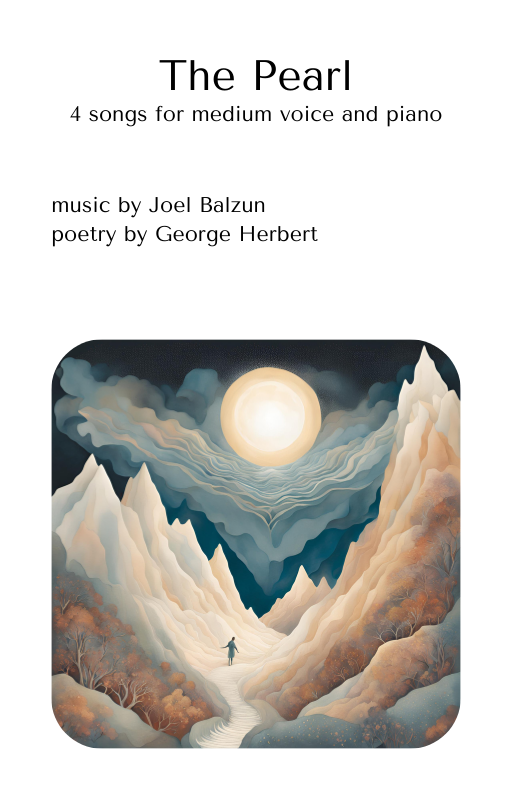
My first voice teacher, Dr. William Lock, passed away on May 29, 2022. He was a devout Christian man who loved music and text. One of my last correspondences with him was a plain card mailed to my apartment which simply read:
"Joel,
When will you become the next Michael Head and accompany yourself while singing your own songs?
Bill"
Upon his passing, I felt the need to fulfill this commission. I immediately turned to the poetry of George Herbert (1593-1633), a mystic spiritual poet whose legacy penetrated music most notably through Ralph Vaughan Williams' "Five Mystical Songs." "The Pearl" is a poem of more epic proportions, boasting four 10-line stanzas. The first three stanzas each magnify the most beautiful elements of learning, honour and pleasure, but curiously end with "Yet I Love Thee." The final stanza reveals that the "pearl" which the speaker seeks is indeed a great reward to be found in Heaven. I could not think of a more perfect poem to honour Bill with.
Of note are three ciphers:
Eb-D-G-Ab-D#-B-A = Ma-R-G-A-Ri-T-A (original Greek for "Pearl" as found in Matthew 13, which is an incipit at the beginning of the poem)
Bb-Eb-A-D-E = P-E-A-R-L
E-A-C-D = L-O-C-K (this appears at the end of each song on the line "Yet I Love Thee.")
***This download is for one authorized use and is not to be copied or distributed.***

Six songs with texts by Edna St. Vincent Millay for tenor, baritone and piano
I. Since Your Love Died
II. I will be the gladdest thing
III. Grey (The Little Tavern)
IV. The railroad track
V. What Path I Take
VI. Love has gone and left me
Note that movement six requires the use of crotales to be played by all three performers, as well as one crotale to be placed inside the piano as a preparation.
***This download is for one authorized use and is not to be copied or distributed.***
C. S. Lewis was known for his highly poetic writing, in forms both prosaic and lyrical. His poetry cycle, “Spirits in Bondage,” is no exception. Written in 1919, Lewis had just returned home from service in World War I. He had labelled himself as an agnostic, looking foully upon God and religion. His main argument against Christianity was its virtue of being something desired yet entirely unattainable by man. This theme penetrates this entire cycle of poetry.
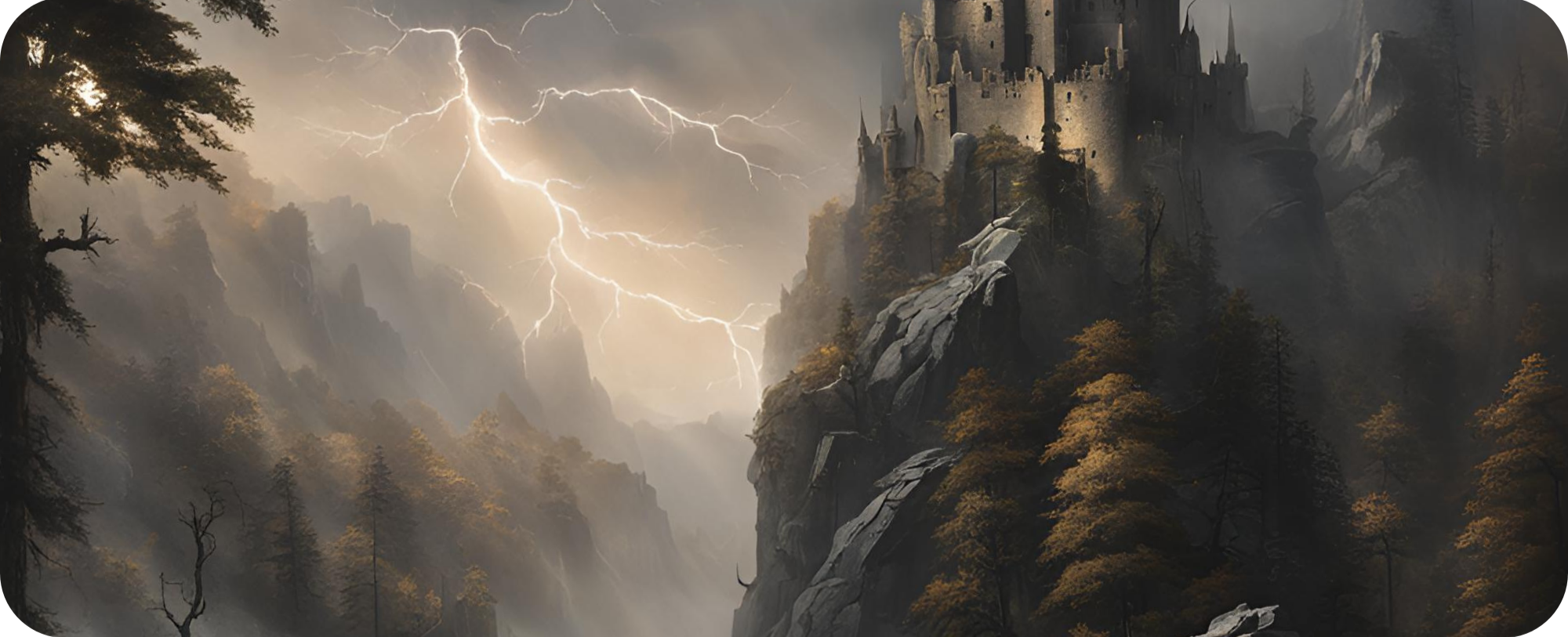
The text for Castle: among that folk, beloved is taken from the second-last poem in this cycle. Originally titled “World's Desire,” this poem comes from part three, titled “The Escape” - the first two sections being named “The Prison House” and “Hesitation,” respectively. Although Lewis certainly maintains a cynical view toward Christianity, it is interesting to note a few themes in this poem – namely, the castle and the ravine. The ravine separates the speaker and his love from the castle. It seems impossible for the speaker to gain access to the castle, which is saddening because he knows inside the castle lies something much better.
It is clear that Lewis is referring to Heaven (the castle) and sin (the ravine). However, the use of the word “But” in the final stanza can imply a shift in tone; does the speaker start to see hope? Does he hear something from the castle? How does he know that within the castle, there is something better? Perhaps this says that Lewis' heart was starting to change. This is why the poem is so intriguing: the simultaneous existence, the mental paradox, of an abundance of knowledge with a lack of belief. This heart change is the thesis of this piece.
This piece is dedicated to my friend, Brendan. I know you know – now will you believe?
Castle: among that folk, beloved was commissioned by the Christian Fellowship of Art Music Composers for their 2014 National Conference. It was premiered on October 11, 2014, by Richard Zeller and the Cadillac Moon Ensemble, for whom the piece is written.
World’s Desire - C. S. Lewis
Love, there is a castle built in a country desolate,
On a rock above a forest where the trees are grim and great,
Blasted with the lightning sharp-giant boulders strewn between,
And the mountains rise above, and the cold ravine
Echoes to the crushing roar and thunder of a mighty river
Raging down a cataract. Very tower and forest quiver
And the grey wolves are afraid and the call of birds is drowned,
And the thought and speech of man in the boiling water’s sound.
But upon the further side of the barren, sharp ravine
With the sunlight on its turrets is the castle seen,
Calm and very wonderful, white above the green
Of the wet and waving forest, slanted all away,
Because the driving Northern wind will not rest by night or day.
Yet the towers are sure above, very mighty is the stead,
The gates are made of ivory, the roofs of copper red.
Round and round the warders grave walk upon the walls for ever
And the wakeful dragons couch in the ports of ivory,
Nothing is can trouble it, hate of the gods nor man’s endeavour,
And it shall be a resting-place, dear heart, for you and me.
Through the wet and waving forest with an age-old sorrow laden
Singing of the world’s regret wanders wild the faerie maiden,
Through the thistle and the brier, through the tangles of the thorn,
Till her eyes be dim with weeping and her homeless feet are torn.
Often to the castle gate up she looks with vain endeavour,
For her soulless loveliness to the castle winneth never.
But within the sacred court, hidden high upon the mountain,
Wandering in the castle gardens lovely folk enough there be,
Breathing in another air, drinking of a purer fountain
And among that folk, beloved, there’s a place for you and me.
***This download is for one authorized use and is not to be copied or distributed.***

for soprano and percussion, with text by an anonymous pastor from Aleppo.
Percussion needed:
Bass drum (two total - one for each performer)
High Bender Gong (also called Chinese Gong or Opera Gong)
Kick drum (two total - one for each performer)
Large Tam-tam
Marimba
"Waiting death.
Here in my room sitting in darkness because we get electricity only one hour per day or less, around midnight, waiting with others in the building where I live for death to visit me. It looks like death is playing with us, like a game of hide and seek.
Two mortars fell on the building in front of us, another to the right, another one on a building just in the next street, but not on ours!
So the question or the questions are: is the coming building ours? But when it will be? Shall I stay in my bed, so I’ll rest in peace on my bed? Or should I go down to the ground floor? But till when will stay there? Should I sleep, or it is better to stay awake to feel the moment when death will come riding on those rockets?
Wow! Here is another one shaking the big building of four floors where I live, pushing the windows violently. And scary screams blow up from here and there. But it is midnight, and there are no lights on to allow me to go out and see what is going on! And what if another rocket fell down when I was out to see what happened?
I think it is better to stay in my room waiting death, who is flying all around here like crazy. At least I took a shower few hours ago, you understand what I mean, don’t you?
Here is another one, I think it is better to keep silent!”
Aleppo, midnight of 1 October 2014
***This download is for one authorized use and is not to be copied or distributed.***
Arrangements

Arrangement of Amazing Grace for TB chorus a cappella, featuring a tenor soloist for one verse.
***This download is for one authorized use and is not to be copied or distributed.***
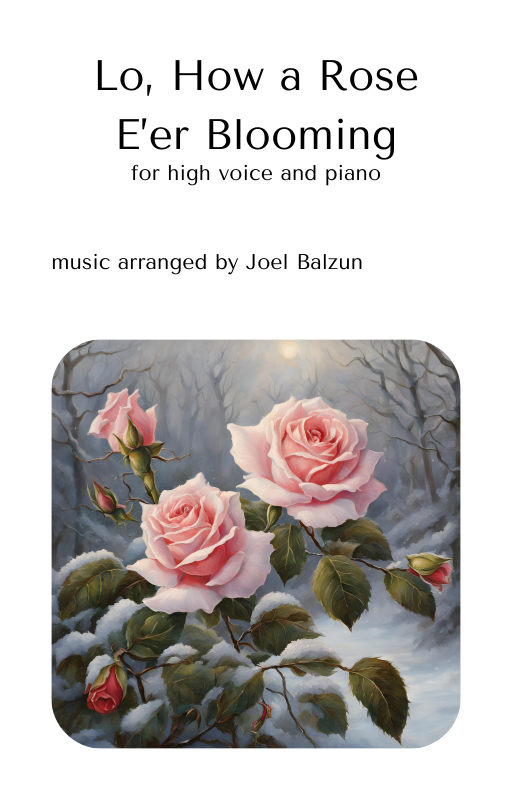
for high voice and piano. range: C4-F5. Appropriate for tenor and soprano voices. Hymn for Advent and Christmas

for medium voice and piano. range: A3-D5. Appropriate for baritone and mezzo-soprano voices. Hymn for Advent and Christmas

for low voice and piano. range: G3-C5. Appropriate for bass, bass-baritone and contralto voices. Hymn for Advent and Christmas
High voice available here
Medium voice available here